
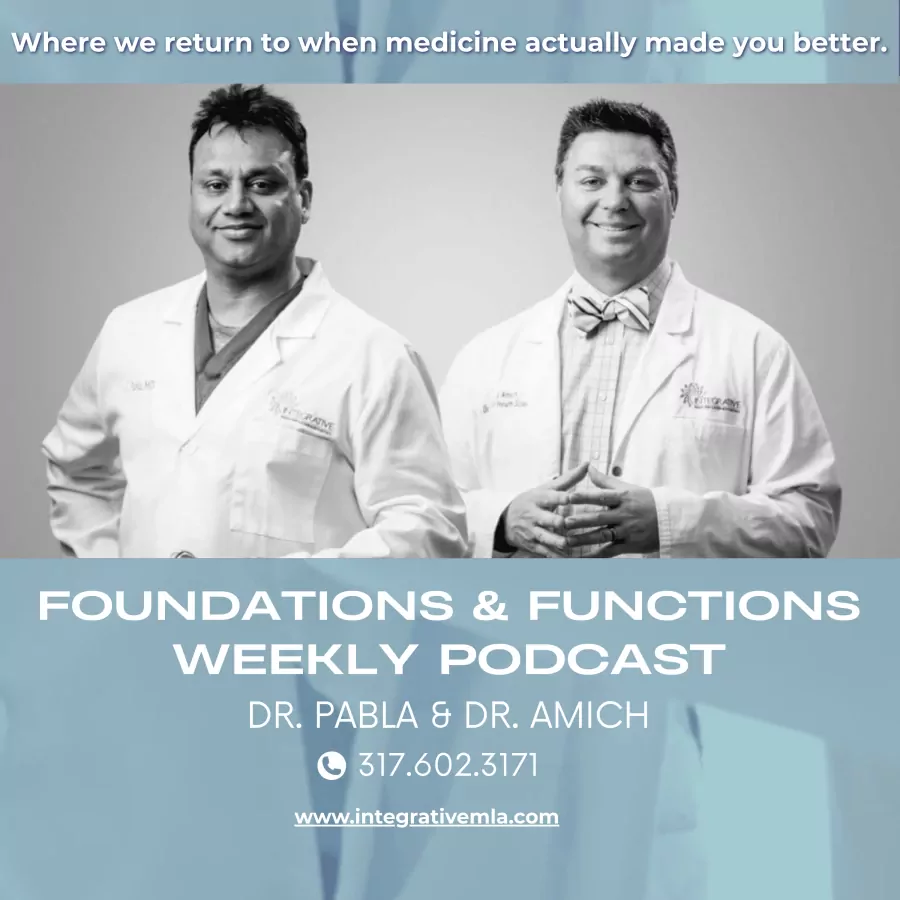
Show Description
In this powerful episode of Foundations and Functions, Dr. Jason Amich sits down with paramedic and military veteran Micah Miller for an honest, deeply personal conversation about ketamine-assisted therapy. Dr. Amich opens the discussion by breaking down what ketamine is, how it works in the brain, and why it has become one of the most talked-about emerging treatments for depression, anxiety, PTSD, and chronic trauma. Together, they explore the science behind dissociation, glutamate regulation, and neosynaptogenesis—offering listeners clear, accessible explanations of why ketamine therapy is dramatically improving lives across the country.
Micah then shares his own emotional journey with ketamine infusion therapy, describing how years of trauma exposure as a young EMT and first responder led to anxiety, irritability, and a loss of joy that traditional therapy and medication never resolved. Through vulnerable storytelling, he walks listeners through his first infusion, the raw emotions he experienced, the transformative breakthroughs that followed, and how ketamine helped him reconnect with his family, regain patience, and rediscover a sense of presence and purpose. This episode offers science, hope, and firsthand experience—making it a must-listen for anyone curious about ketamine therapy or seeking new paths toward mental health and healing.
Show Disclaimer
The information provided in this podcast is for educational and informational purposes only and is not intended as medical advice. The content is not a substitute for professional medical care, diagnosis, or treatment. Always seek the advice of a qualified healthcare provider with any questions you may have regarding a medical condition.
If you would like more detailed medical information, please contact Integrative Medicine through their website at https://integrativemla.com/
Show Transcript
- Welcome to Foundations and Functions Weekly Podcast, where we return to when medicine actually made you better. The information provided in this podcast is for educational and information purposes only, and is not intended as medical advice. The content is not a substitute for professional medical care, diagnosis, or treatment. Always seek the advice of a qualified health care provider with any questions you may have regarding a medical condition. Now, here's Dr. Jason Amich and Dr. C .J. Pabla.
- 17 0:36 Welcome
- 1 0:36 to Foundations and Functions. I'm Dr. Jason Amich and here with me today is Micah Miller. Today we're going to talk about ketamine and ketamine infusion therapy. Interesting things that are happening right now in the field of behavioral health is the use of ketamine assisted therapy for treatment of depression, anxiety, and even post -traumatic stress disorder. And some clinics are even using it for fibromyalgia and some chronic regional pain syndromes. So let's talk about briefly here, before we jump in, giving kind of some groundwork of what ketamine is. So ketamine is a dissociative anesthetic, and that's a little bit different than the benzodiazepines or some of the other narcotics that are out there. And one of the, you know, The best ways to describe it is it's a anesthetic that puts you in a state where your brain just kind of disconnects from reality. And one of the nice things about it from an emergency medicine and critical care, which Micah and I both have backgrounds in that, is it doesn't have a central nervous system or respiratory depression. So
- 1 1:44 we're not concerned about patients stopping breathing when they take this medication. And so what we know is ketamine gets converted into what's called norketamine and it acts on what's called an NMDA receptor in your brain. This is an important receptor. one of the main jobs of this receptor is to regulate glutamate. So everyone knows about dopamine and serotonin. We talk about depression specifically. But glutamate is actually the primary receptor. excitatory neurotransmitter. So again, a lot of fancy mumbo -jumbo words, what does it mean? It's a chemical that your brain uses to stimulate neurons and stimulate activity in the brain itself. So there's some theory behind the fact that things like anxiety and even post -traumatic stress disorder, that these things are a direct response to over stimulation or dysregulation of that glutamate molecule. So one of the things that the ketamine does is it actually blocks that receptor that manages the glutamate, and so what ultimately happens is initially you get a surge of glutamate, which sounds kind of counterintuitive, like why would you want more glutamate going into the neurons?
- 1 2:58 But over the next 24 hours, there's actually a down regulation of glutamate, and that's where some of the therapeutic effect comes from. So in the moment during the therapy itself, patients often have this pretty significant dissociation of reality, and even the surge of glutamate, But over the next 24 hours, there's actually a leveling off of that glutamine, actually in the neuron itself. Why is that important? It's important because, and there's a great Yale video. You can go to YouTube, you can look up ketamine in Yale. There's an awesome video that really does a good job explaining it. But one of the things that they found is that actually, generates what's called neosynaptogenesis and that's kind of cool in brain biology and neurobiology. The effect of sub -anesthetic dosing of ketamine actually causes neurons to get stronger and actually improve that synapse, improve where one neuron bumps up against another and then your ability to
- 1 3:55 transfer electrical activity across that neuron improves pretty dramatically. So that's one of the key findings that scientists have realized really helps ketamine address things like depression, anxiety, and even post -traumatic stress disorder. So with all that kind of in the background, I want to turn to my guest, Micah. And Micah, go ahead and introduce yourself.
- 10 4:20 Yeah, yeah.
- 2 4:21 Dr. Emick, thanks for having me. I appreciate it. We've been friends for a while now. We've been colleagues going on two years now. So it's a pleasure to be here with you.
- 16 4:28 Oh, thank you.
- 2 4:28 Talking about this.
- 1 4:30 Glad to have you, brother.
- 2 4:31 It's pretty important. And it's affected me in a lot of positive ways. So I'm glad to share that news. So my name is Micah. I'm 29.
- 15 4:37 I'm married.
- 2 4:38 I have a wife, three kids. I've been in the military for 12 years now. I've been in EMS for 10. Nine of those as a paramedic, and the last two years is when I've started getting into critical care and dabbling into ICU -type medicine and things like that. So that's a little bit of my background.
- 1 4:55 So you're never in the same boat. We're extremely familiar with ketamine We just get it probably almost every time every day. We touch a patient. We're somewhere in our brain. We're thinking how can I use ketamine? It's a great drug. It's a very safe drug in the right hands as most things are absolutely so Talk to me a little bit about when you first heard about Ketamine -assisted therapy what what went through your mind?
- 2 5:20 Yeah, so, you know, like you said, I use ketamine all the time at work, but I never really heard much about it until I had a couple friends go and get ketamine infusion therapy. It was just really intriguing to me because a lot of people that are near and dear to my heart, soldiers, first responders, things like that are seeing a lot of benefit. They're seeing a lot of healing for their PTSD, depression, anxiety, things like that. So that was really intriguing. I'd kind of heard about it, maybe read some studies, listened to some podcasts.
- 2 5:49 before I had friends that went and did it. And then I heard about them doing it. And then one friend actually asked me about it before they went and got their ketamine infusion therapy. And at this point in time, I was already kind of thinking about it. So I was really excited to see how she was going to be affected by that. She has a lot of depression, some PTSD, really bad anxiety. So she went, she had it done, and I was like, It was transformational, life -changing for her. So the decision was pretty much already made, but seeing someone that's a friend to me go through that and have such positive change kind of made me pull the trigger.
- 1 6:28 And were you hesitant at all about it? Were you nervous about it? Skeptical even?
- 2 6:35 I don't think I was skeptical. I was nervous. I feel like my knowledge of ketamine and the potential things you have to worry about, all those were kind of in the back of my head of what if, what if this happens to me, even though objectively I know that's probably not gonna happen. So I was mostly optimistic, mostly excited, mostly, I mean, I was obviously accepting of the treatment and glad that I saw some friends get improvement from it. But yeah, that's that's pretty much it. I was pretty much on board and ready to do it with some hesitancies.
- 1 7:05 Yeah. I didn't think I heard it. It's OK if you don't want to share it.
- 14 7:08 But what what were some of the things you were struggling with that made you think ketamine might be the right choice for me?
- 2 7:14 Of course. Yeah. So, I mean, delving a little bit more into my backstory, I started EMT school or first responder school back when I was 16. So, at 16 years old, I was doing clinicals at Level 1 trauma hospitals. Some of the first things I saw were cardiac arrests and gunshots. Those were my two on my first shift as a 16 -year -old in the ED. Those are the things I saw. So, and of course, as I progressed in my career, I got my EMT. I went to the military. I got my medic, and then soon thereafter, I started working in hospitals. Indianapolis, Metropolitan 9 -1 -1. And all the things you would expect to be the outcome of that are true. I saw a lot of terrible things, experienced a lot of terrible things, especially as a young person. I feel like those weigh on you more than you think. And as a young person, you also, like many others, you think you're just on top of the world, nothing can hurt you, especially as a man. You know, I'm all right. I'm conditioned to manage my emotions and not really show that and all those societal things.
- 2 8:16 And I neglected that for a long time. And it was thanks to my wife, you know, that she kind of said, hey, you need to kind of get this under control. It may cause issues in the future. And it did, so I'm just the typical first responder case of seeing a lot of really bad things, in my case, from a really young age.
- 1 8:32 And they took their toll on me over time, and it caused a lot of things at home that were less than ideal, and not who I really wanted to be.
- 2 8:42 So, yeah. And had you tried other treatments before ketamine, were there things that you'd done? Sure, yeah, so I kinda did the whole thing. I've been through, a dozen or two dozen therapists, I've tried all the medications, I've had all the side effects. There may be a fleeting time span where I may have had a little bit of improvement, but dealing with the side effects and all the therapists and not really getting the experience from them that I wanted, the understanding, it didn't really help anything. So kind of a lack of options, having tried everything conventional, I didn't really have anything to lean on, so I just kind of went without any medications, any therapy.
- 2 9:23 I'd been burned so many times, and it was upsetting. So I just kind of pulled myself up by my bootstraps and tried to do the best I could for a long time. And that wasn't doing it.
- 1 9:33 So that went on for a couple years, and then I heard about ketamine infusion therapy, and it was kind of the last Hail Mary in my life. for my sanity and my happiness. And I want to get into that a little bit later, kind of the end result of the product of that. But kind of go back to your first Can you describe that first ketamine infusion experience that you had? And I'm gonna preface this with, I understand, I've done it enough to know that it's hard to verbalize sometimes.
- 2 10:06 It's hard to find words to describe it. But as I know you've thought about it a lot, I'm really curious, and I think listeners are gonna be really curious to hear how you experienced that first ketamine dose. Yeah, it's honestly, it's quite frustrating because A lot of this stuff is pretty cool. It's kind of the psychedelic experience where you have these integrative experiences and thought processes and light bulbs turn on in your head and things make sense after years of not making sense. And you try to put those into words and like you said, there's just no words to describe it. So it's kind of frustrating, but I'll do my best. The first one was a little bit of anomaly, of an anomaly because kind of like I alluded to, knew about ketamine, I knew the potential. When I was first going through the ketamine therapy, I don't like the feeling of losing control, and I also had this knowledge, more than just the average person that doesn't deal with ketamine every day has, and that honestly gave me a lot of anxiety, being out of control, this new sensation, feeling that I've never experienced before.
- 2 11:11 So the first one, in my case, was a little bit rough, because I was just really anxious, and it kind of took away from the potential positive experiences that I could have had at being my first therapy. But I had my wife there.
- 1 11:26 She's obviously incredibly supportive of this journey and me doing this. So that helped, but it was a little bit nerve wracking.
- 2 11:34 And it's hard for people like you and me because we we tend to be the ones that are jumping in hands and feet and and taking care of people then when we're in a position where we may be vulnerable we're like wait a minute if something bad happens who's gonna we know all the crazy potential bad things well right you know who's gonna do this thing for me if I'm the one that needs the help. So, yeah, sure. I'm not the vulnerable one.
- 1 11:57 I'm the person that is in control of these things. It helps people.
- 2 11:59 I'm the one that's fixing it. Do you remember any kind of specific emotional or even physical effects that you felt? Yeah, it's very, very emotional. So it just breaks down all the barriers and the presuppositions and all these things that occupy our minds every day. And you're just incredibly raw.
- 1 12:23 And this spans across all the emotions too, anger, happiness, sadness.
- 13 12:30 anything like that, you experience that at a much greater magnitude.
- 2 12:34 Did you experience that during the session itself, during the infusion? I did. So it took about half the infusion for me to just kind of settle down. I had to ask my wife to kind of come for me a little bit because it is very strange in a good way. Yeah, so about halfway I got through all the anxiety and I did my breathing techniques and my wife kind of helped me a little bit. And the last 20 minutes was pretty cool. experienced a span of emotions. One of the first things that pops into my head was my kids were kind of appearing to me and fading away and rotating around my head. And it's not extremely vivid. It's dreamlike. So when you're experiencing it, it's very real.
- 13 13:16 But then when you wake up, so to speak, like as in a dream, It's kind of different from reality, but it feels so real when you're in the middle of it.
- 2 13:26 So I experienced that and that gave me a lot of happiness and joy and things like that. that. And then there was kind of some negative emotion that I felt, but I couldn't quite put my finger on it, but it was just kind of there. And that was pretty much the end of my first ketamine. So yeah, I experienced a little bit of everything, anxiety, happiness, sadness, the dreamlike, some of the visual things.
- 1 13:51 So yeah, it was interesting.
- 2 13:52 I went home and had to kind of process things a little bit. So you went home, so what was that first 24 hours like? Yeah, so this happened the first time and it happened throughout the ketamine therapy. So there's a time where you can't quite make sense of exactly what you experienced or why you experienced it. And then you get home, and it usually takes, for me, 24 or 48 hours. And then you may have some type of, you'll literally sit down on the couch or whatever, and it'll just come into your mind of, oh, that's what that meant. You know, whatever it was. Throughout this whole journey, there was the integration process of, oh, yes, I see kind of what that meant, you know. But the first one was just kind of getting the swing of things. Yeah, I felt happiness seeing my kids and things like that. So not much with the first one, I think. the anxiety and the fear of being out of control and going through a new experience that's kind of outside the norms that we hear about all the time, kind of overran that.
- 1 14:50 And I was told by the clinicians that aided me along this journey was, we wish everyone could have the second ketamine infusion experience the first time. If they could just get through If they can just get through that and have that experience every first time, they're going to realize that it's really not that big of a deal and it's just new and kind of scary. And so much of that expectation, one of the things I share with folks about ketamine is, you know, that setting the expectation for that first infusion and all of them are important. So environment makes a difference. The lighting makes a difference. Having support of people around you. One of the interesting things, an article I read talked about that having cognitive behavioral therapy within 24 hours of that first infusion has a dramatic difference. Even if you've been in cognitive behavioral therapy for a long time, and some patients even plateaued, like, ah, it's not really working for me. that within that first 24 hours of having ketamine infusion, exactly kind of what you're talking about, your brain's almost open to the therapy, right? And so connections are being made that maybe were challenging before, that you couldn't see or feel or sense before.
- 1 16:03 And so I think setting folks up for that kind of helps reduce that anxiety quite a bit. So you had the infusion, you kind of processed the first 24, 48 hours.
- 2 16:15 When would you say you felt like this really made a difference for me. And some of the things you were challenged with before the infusion seemed to be improving, getting better, however you would, I'm not gonna put a bird in your mouth, but you know, whatever, however you would feel like, wow, this worked for me. Yeah, I think by a few days after the second infusion, which I went in there and I was like, okay, I've done it. I can get through this. I don't have to be anxious about it or whatever. I just need to sit back and let the experience take me where that experience is gonna take me. After that second infusion, it was a very positive experience. And then a few days after that, some of the integration, things like that are happening. And by the third infusion, I was just on cloud nine.
- 2 17:03 I think at the third or fourth infusion, I retook, because we did the anxiety and depression evaluations, the standardized evaluations beforehand. And by the third infusion, I decreased by like 12 each. I was like 18, 19. and I was down to four and five and six. So I was really feeling good and I was excited. And I had a few specific things that happened to me that kind of helped me integrate everything. But yeah, it was second or third, about halfway through, because you get six total for the initial set of infusions.
- 1 17:40 And I was feeling great. I was feeling great by the third one.
- 2 17:43 So how would you say it affected your mood, your sleep, your relationships? How has it affected those things for you? Yeah. So what I kind of struggle with is, I wear a lot of hats. I have the army thing, and I have the paramedic thing and I come home and you know, you have to take those hats off and sometimes you see hard things to do with tough things and you have to just kind of take that hat off and put your other five hats on, husband, father, you know, friend and things like that. And for some reason that transition of my entire adult life has been kind of difficult for me. And that was one of the first things, besides just generally feeling better, like maybe a little more energy, I slept a little bit better, but coming home and making that transition into the house with, you know, I have three young kids, you know, so they wanna see me and they're loud and they're running around.
- 2 18:33 Maybe I just want a minute to kind of settle down before I get into things, but that's not an option for that day, because we have things to do, life things. So that was the biggest main thing I noticed is that that transition was so much easier. I could come home and I could just be present. I was, I had a less short of a fuse. I was very patient. I was much more intentional about the time I spent with my children. Things brought me joy more fruitfully, you know, if I had to go out and do something with the kids, go to the zoo or whatever, usually it was just, everything was just a step in a process of things we had to get done. And it overwhelmed me. right and you know packing up the kids going to the zoo and Enjoying a day with the family was easy for me and fun for me After the academy interesting. Yes. Yes.
- 1 19:28 So that was that was a Big deal. Yeah, that meant a lot to me. That's amazing. So you did the standard kind of six six infusion protocol How long would you say? it lasted. Have you done any tune -ups or boosters, so to speak? And I realize it's important for everyone to realize that it's going to be individual, right? Some people may go months. Some people may go several months.
- 2 19:59 It kind of depends on your pathology and where you are in your life cycle and that.
- 4 20:03 But just in general, did you feel like these were lasting effects for you? Yeah, it lasted because I got mine done in August and it lasted about two months.
- 2 20:12 I just had my seventh. I just had a two month. Yeah, recently. However, there were a lot of things that were happening in my life that were kind of outside of the norm. there was three or four things that were big life decisions and big things that were going on that could affect me and my family. That happened all at once. So that did kind of, I felt like I kind of backtracked a little bit. So I felt like I needed to go get kind of a tune up. Some of the irritation, irritability and lack of joy and contentment and things that I didn't have to deal with for the last couple months were kind of creeping back in sooner than I kind of wanted. So I did have to go back. But I do think that was an outlying case. There were things that happened that were outside of my control that I feel like without that, maybe I would have been okay to go a little bit longer.
- 2 20:58 I do also want to say that I admittedly could have been a little more intentional about staying up on therapy, journaling, social media. hiatuses, reading, getting to bed on early. And I'm sure we'll probably get into this a little bit, but that's really important to keep up on all that because ketamine is only one part of the journey. And I feel like maybe other people have fallen into this trap as well, but I was like, I feel great. better than I felt my entire life, my entire adult life at least. So I'm just gonna ride this train, this is great, you know?
- 1 21:35 And I don't think I quite did enough to be as unwavering when that wave of life things happened. So I feel like, you know, Retrospectively kind of criticizing how I'd handle things I would warn people to make sure you stay up on it because ketamine is only one part of the joint and you're exactly right. There's a therapy trap and Everything right? We see it with mental health people get on a medication medication works and they feel like oh, oh I don't think I need the medication anymore, because I feel great. Or maybe they're hypertensive, they have high blood pressure. Like, I don't have high blood pressure anymore. I'm doing great. And they kind of fall off that therapeutic wagon, so to speak. But it's because there's this trap of, oh, I'm getting better. One thing that I talk to people about, and I say, listen, look at the people around you.
- 1 22:25 And give one or two people that you really trust permission to let you know what's happening.
- 2 22:33 Because sometimes I think, you know, other people may see things before you see them. So I ask you that to lead in, would you say your, did your wife kind of notice you sliding a little bit more before you did, or she did? Yes, yes. She, she is the rock in all of this. She's my person. She's my, you know, so she's, she's great. She's very encouraging and supportive. And sometimes you're willing to hold my nose to the grindstone and make sure things happen for the betterment of our family, you know? So I noticed it.
- 2 23:05 but I almost didn't want to notice it. I'm like, no, this can't happen. I just did this thing and we were doing so well. Why would this happen to me? I was feeling so great. So that's another thing too. She was always a person that we talked a lot, especially during the first six, we talked a lot about, okay, where are you? What are the new things that are coming into your head or experiencing? Or what are these light bulbs that are going off that you're integrating? that the things previously that didn't make sense and now they're making sense and you can kind of reconcile those and So yeah, she noticed me kind of slipping off a bit and held me responsible so I went back and had my my seventh infusion.
- 2 23:44 And since then I've been much more proactive about maintaining my mental health, you know, social media hiatus.
- 8 23:50 I'm reading the books that have been in my read, I want to read for, you know, years and, and things like that.
- 6 23:55 And I'm feeling amazing.
- 1 23:57 That's awesome. Yeah. Good. Yeah.
- 12 23:58 And again, that's so important to have that support system around you.
- 1 24:02 And again, sometimes just having someone hold a mirror up, you know, and so I've had patients that I've talked to and the husband will say, you know, you didn't used to care about, that thing and you're getting really sensitive about things again, maybe it's time to get a ketamine infusion. So that's an amazing, I'm so happy that you had that. We're gonna talk about your journaling here in a little bit, because I know that you kind of dove into, that's how you and I were having this conversation, it was a late night conversation, a couple of buddies, but I went, wait, what are you talking about?
- 1 24:34 But that's crazy. And the level of journey you did was really phenomenal. And so I want to kind of pull some of that out in a little bit. Did you feel like you got any misinformation or any stigma about doing it? I know we talk a lot about men's health, men's mental health. There's a lot of stigma. We even kind of touched on it earlier on a few minutes ago. You know, we've got to be tough, right? And especially in a lot of places,
- 2 25:00 responder roles, there is absolutely the expectation that you don't break. And if you can't handle it, then there's an inherent flaw. And you as a person, you as a provider, you as a whatever, role, value, expectation, you wanna put on that. But as you were kind of developing this journey, or even after, did you feel like you got any misinformation or stigma about ketamine? No, no, I don't think so, because a lot of my friends are in this business, so they're aware of ketamine and its use cases, and my family just wants the best for me, and I'm one of the only medical providers, so they're like, whatever you say is gospel, we don't know.
- 1 25:39 So if you think it's gonna be good, than we trust you, and we just want the best for you.
- 2 25:43 So maybe I'm lucky. I'm sure, I know there's some skepticism out there, but from a friends and family perspective, I got nothing but support, thankfully. I did get some skepticism and pushback, but it wasn't from who you would think, so we can kind of get into that if you wanna. Yeah, I'd love to hear that. Yeah, so I know where you stand on therapy and things like that, and I mostly agree with that, too, for anyone else. I think that's a good, Initial step to okay. Let's let's hold this accountable. Let's make sure we're being proactive In our aftercare, so to speak and staying on top of things like I failed to do so I think it's really important I think if you do it, that's a good first step in addition to having your family support kind of squared away and had them on board but My wife kind of pushed me into Okay, it's been a couple weeks.
- 2 26:33 We're feeling good, but we don't want to lose this, you know, so and this this is Thinking back as I'm talking about this this may have been kind of a catalyst to me kind of falling off the slope a bit as well But like I said earlier, I've had a lot of issues with personally with therapists. I'm not having my best interest at heart I'm not having good experiences really really negative toxic So I went to, personally, I went to a therapist, and there was a lot of pushback, a lot of misunderstanding, and I could tell she maybe wasn't read up on it, so maybe that's where some of the skepticism came from. But I went, I was vulnerable and this is all kind of hard being vulnerable in these new ways. So I went and opened up about the whole process and I was vulnerable with her. And she was the first person outside of my family who, like I said, I'm blessed that they're all supportive of me, about the Academy experience. And she was very unsure of whether or not it was the right thing to do. She kind of alluded to the fact that there was not really much literature, which, You already knew.
- 2 27:41 I know to be false because I've read up on a lot of the literature, study after study after study, preparing for this, maybe too much, which is what contributed to my first experience. But I knew that to be false. For someone to obviously not quite know what's going on with something and then have someone who is vulnerable come into their space and it's their job to make those people feel safe and heard and whatever, that was really, really frustrating for me.
- 5 28:14 So I think that was kind of the start.
- 1 28:16 I was in a really bad mood. I tapered off of all the highs, the benefits of the ketamine for a while, and then the other life things happened. So I feel like that was just the catalyst to the downslope. Yeah. I'm sorry.
- 2 28:30 I'm really sorry that happened to you.
- 1 28:31 That's okay. And I think that's why this is important to talk about it, do some education, let people kind of know. And look, there was a very, very public story that involved ketamine and I think most health care providers understand like we talked about early on is that you know the the bad outcome from that very public figure probably had less to do with the actual drug itself and more about the truly unsafe environment that it was being used, the lack of monitoring, and that sort of thing. So. Set and setting is very important. Set and setting is very important. Monitoring, you know, having skilled people around you who know how to, you know, manage, you know, anything that may, you know, whether it's an allergic reaction or maybe it's a, you know, hypertensive crisis or, you know, who knows, any number of things. Having someone nearby who, you know, You know can actually manage those things medically clinically in an emergency is vital to this way, right?
- 2 29:26 We know any drug is safe and any drug is unsafe depending on whose hands are in so So I'm really sorry that that that happened But I think more and more as these studies as more and more people are paying attention to this again Whether it's ketamine or ibogaine. I know you and I talked a lot about that. Maybe we'll do a whole show on ibogaine today, but We'll have to take a little trip and then maybe we'll see that. I want to go back real quick. Was cost a consideration for you? Was that something that, did you feel like that was a barrier to getting ketamine? You know, it certainly stings, you know, no one wants to, you know, I'm very financially minded and I'm worried about those things. And my wife stays at home with our kids, so I'm the only income. So there's all these factors that would make anyone worry or maybe second guess. But for us, it was the Hail Mary, it was the last option that was available to us because we try everything.
- 1 30:25 So it might sting a little bit, but it's worth it. And it only stung in the beginning when you had to swipe the card.
- 2 30:33 And after that, by my second treatment, I'm like, this is worth it. This is worth it, 100%.
- 1 30:39 I would pay double the cost for what I paid to have this type of benefit and to have this type of treatment.
- 2 30:45 chance and newfound hope for what my future could be when previously that was inconceivable. Yeah, wow, amazing, okay. So what do you wish that, you know, if you had a couple bullet points you could think of that if someone was listening and thought, you know, maybe I'm interested, maybe not, what are a couple things you think that they absolutely should know about Ketamine -assisted therapy. So it's gonna be a journey. And it's not unlike going to, if you've been to therapy, you know, you go to therapy, you bring out all the skeletons in the closet, and then you kinda go home feeling worse than you initially went in, and you were hoping for some benefit, but then you feel worse because you just pulled all these things up that you really don't wanna think about, and they're uncomfortable.
- 1 31:35 Ripped open these wounds that have been closed.
- 2 31:37 Yes, yeah. The difference to me, though, is that ketamine opens up all those wounds, but then it heals it in the end. Because therapy, I feel like I went out and I talked about all these things that are hurtful and troubling and regrets and all these things that everyone deals with and I didn't really get any benefit on the back end. I just went and opened it all up for no real reason.
- 1 32:01 Ketamine, It opens everything up, it paves a new path, and allows integration and healing on the back end of that, fairly quickly, within 24 to 72 hours, depending on the person and circumstance.
- 11 32:14 Yeah, that's what you experienced, right?
- 1 32:15 Yeah. That's just from my reading and my personal anecdote. So that's the main difference.
- 2 32:22 So just know that it is helpful, it is healing, it is transformational and all the things.
- 1 32:31 Yeah.
- 10 32:31 Okay.
- 1 32:33 Do you see it as a lifelong therapy? Do you think this is something that you may need or want? to continue? I mean, ideally, I want to get to a point where I'm not reliant on anything. What I'm hearing from you is really, this has been a bridge for some significant growth and healing for you. Yes. Is that fair to say? It is, yeah. And it's not a bridge you want to burn, right? No.
- 2 32:58 So you can certainly cross it and tap into the benefits of it later on down the road. What are some things you're grateful for? And again, I know you wrote your journal, so I'm happy to let you dig in as much as you want.
- 9 33:15 But when you think about, and that was one of the things that I listened to you really intently when you were sharing this story with me.
- 2 33:21 And I was really blessed that you bothered to share this with me. And I thought, man, this guy, he really took a lot of things out of this. And it meant so much to you. So what are some of those things that you feel like really Reflected what you gained out of this ketamine infusion therapy.
- 1 33:41 There's a there's a lot that plays into that I feel like you know, like I said, I'm 29 So basically a decade in my 20s now in this business doing what I do Seeing the things dealing with the negative outcomes mentally with the Irritability and not being present and when I'm home I'm dissociated and I'm not really there for my family and my kids my wife like I want to be personally the standard I hold For myself a lot of fleeting moments that I'll never get back were stolen from me right because of my mental health and because of my preoccupations and things like that and things one day I'm going to be on my deathbed looking back on my life and those are the moments that are really going to mean something to me. It's not my career. It's not, you know, whatever. It's, it's that.
- 2 34:35 moments. And it's really sad for me to look back and know that I don't have those, because I wasn't there, at least like I wanted to be. And those little fleeting moments were given back to me with ketamine. So it's a big deal, it's a big deal. It's a lot to be grateful for. Do you have a couple of moments in your journal that really stuck out to you, some of those aha moments?
- 6 35:09 I know you do.
- 2 35:10 Do you want to share any of those? Yeah. So I'll share, I guess I'll share one thing. So there's a couple. But the first thing, I've always been a night owl. I stay up late, I'm on my phone, I don't get good sleep, I don't get rid of the blue light by 11 p .m. and all these things. Oh, you're making me so mad right now. Go on, go on. I'm getting better, it's a journey, it's a journey. But I've always just chalked it up like, I'm just a night owl, that's just how I am, that's just my nature. I'm not a morning person, I'm a night guy. And I literally came into my living room one night and I sat on the couch and we were getting ready to go to bed, my wife and I. And it just pops into my head. It
- 2 35:54 wasn't something I thought about. It wasn't something that I had been kind of toiling with and trying to integrate. And that's the thing with ketamine, those things happen. These aha moments just kind of appear out of nowhere as if someone else planted it there. And I realized that I stay up late and fall asleep watching YouTube or listening to a podcast or whatever the case is, because I don't like being alone with myself. Because when I'm alone with myself, tend to hold myself accountable. And we replay moments of the day. And as we've kind of talked about, a lot of those moments are less than optimal.
- 2 36:30 I wasn't as present with my kids as I wanted to be. I wasn't as gracious and forgiving with my wife or my friends or my parents. And I realized that I just am avoiding that. And it's something I've never thought about my entire adult life. I've just said, I'm just an eye dialer, just how it is. So that was a big moment that just integrated about 48 hours after, I think, my third treatment. These are some of the things that kind of happen with ketamine is you realize and you learn things about yourself that you've never known, that you've explained away as some other anomaly. And so that was a really big one. It's like, oh, okay, well, now I have this information.
- 1 37:13 I can do something with that. If I have these things that I need to reconcile that I'm avoiding purposefully, Well, maybe subconsciously, I guess.
- 2 37:21 We can get Freudian about it.
- 1 37:22 But maybe I should probably deal with these things. So that's been kind of part of my journey. And this isn't a quick fix. You get benefits really fast. But I just want to reiterate that this is a marathon, not a sprint. This is only the catalyst to the change. Right, right. More work is required.
- 2 37:44 100%. More things have to happen. So yeah, I think as we talked, using the concept that this is a bridge to healing. It'll kind of help get you there, but you gotta cross the bridge. You gotta take the steps and do the thing. So, Micah, tell me a little bit about, whether it was during the infusion itself or maybe even during the immediate post -healing that happened afterwards, what kind of experiences were you having? So, I know you haven't been a great sleeper, but you did say you were sleeping better. Were you dreaming more? Were you getting more out of sleep? Yeah, so I did a lot of, we talk about set and setting of things, I did a lot of lot of preparation with meditation, going to bed at 11, putting the phone down 30 minutes before bed, diet, hydration, things like that. I did all that, so I really focused heavily throughout the entire six infusions and after as well, but especially during the initial six on getting my mind right.
- 1 38:47 particularly the night before. So yeah, I focused heavily on that.
- 2 38:52 And then when I would go in, I would have very dreamlike experiences. My experiences weren't as visual as they were, it's hard to explain, emotional, visceral. I did get some visuals, some colors. One way they described it to me before I started was you may feel like you're floating, because it is dissociative. So I experienced, like there was one time I was in a recliner with my eye mask on and my AirPods and listening to some of my meditative music.
- 8 39:33 And I just started rocking back and forth like I was floating in water.
- 2 39:38 But that's why it's good to have a person there I can say, hey, come hold my hand and make sure I'm still in reality here.
- 7 39:43 You mentioned music before, and that's something that I absolutely use for ketamine patients.
- 2 39:51 So did you have your own set list, or did you make a set list, or where did you, tell me what the music that you used. Yeah, so I think this is, I actually, coming into this, I wanted to, let people know some things to think about or expect or prepare for that maybe I didn't get exposed to as much as I would have liked or tips that I wish I would have gotten beforehand.
- 1 40:18 So music's a big one.
- 2 40:20 and it's all part of the process of leading up to and getting your mind right for this type of experience. So listen to some meditative music, find what you like, find what makes you feel comfortable. So I made that playlist, and I went into my first couple pretty confident, and then I found that some of those songs that were fine when I was just meditating at night right before I went to bed were extremely overwhelming when I was the middle of the ketamine treatment.
- 1 40:50 During the infusion? Yes. Oh, wow. So much so that it gave me a lot of anxiety and took away from the experience a little bit. So I would say less is more when it comes to how stimulating the music is, at least for me.
- 2 41:02 Yeah, maybe no scream rap.
- 6 41:04 No, definitely calm music.
- 1 41:07 It was all calming like meditative music, but even that was really overwhelming when I was so raw and emotional, and you're experiencing all these things, and it can kind of be anxiety -inducing sometimes. So maybe it's just something to think about, maybe go on the more docile end of the meditative music, nature sounds and things. Yeah, that's great. That's great advice, because again, you know, we are Stimulating the brain and and I would just recently had a really awesome conversation with a friend of mine about you know The the physics of music and and how crazy music is from the perspective of their sound waves Yes, they get converted to electricity in your brain and yet they can stimulate such strong emotion just from you know a vibrating string on a guitar Hits your eardrum gets into your brain and can you know?
- 1 41:56 can take you back like that to a memory and emotion, or actually elicit a whole emotion. So the musical journey is very important. I actually have a standard set list that I kinda have patients like, listen, we're gonna use a set list, because I don't want them to bring in the scream rap or... Yeah, yeah, yeah. You know, the... from the scariest movie they've ever seen, that sort of thing. It's very calming, very reassuring. But I also try to make sure that we're gonna individualize that for every patient. So I'm glad you brought that up because I think that is so important, the preparation beforehand, eating well, sleeping well, the meditation.
- 2 42:38 Again, you don't have to take my word for it. You can go out there and read literature about the power of meditation or prayer or whatever you want to call it, calming your mind and centering yourself inside of yourself. I don't know if that makes a lot of sense outside of my own brain, but those sort of things are so important. parts of this journey. So to me, I would say, it's like packing a bag for the trip. You got stuff you have to bring along. You got things you have to do before you go on this journey. And getting your body healthy, that's one of the things that I do a lot, I talk a lot about, getting good gut health, getting good sleep, reducing inflammation, all these things, helping not just your body, but also your mind. And keying you up for the best outcome we can get, when you're ready and prepared for it.
- 2 43:30 I feel like doing all those things really, really helped me. Maybe I would have been fine without doing that, but I feel like it's an essential step of getting the mind right. This is a psychedelic experience at the end of the day, so you want to be really careful when you're when you're kind of toying with that side of your brain and being so raw and open to feeling and expressing emotion and things, I think it's very important to get the set and setting correct. And the music was such an integral part of the experience for me. I mean, if, and I did have some visual, I would see like mountain scenery every now and then, illuminated by a night sky with stars and shooting stars.
- 1 44:09 and things like that. So it is kind of cool, but it's dreamlike and kind of obscure and faded, but it's still very cool to see. But some of those experiences and the colors that you would see and flickering of light in your peripheral vision and by the way, your eyes are closed behind a mask. So these are, it's all just in your head. And so it's very, very interesting. But these experiences would ebb and flow with the music. It was very fluid.
- 2 44:35 If the music kind of crescendoed a bit, the experience would crescendo, and you would see more colors, and the colors would be brighter, or the sky would move. So it's very important. Yeah. It's interesting, too. Maybe someday someone will do a lot of study on this. The things that you're describing are very consistent among patients that have had ketamine therapy. The water, the shrinking, the exploding. I mean, it's very interesting the commonalities that people have from very different walks of life, from having very different experiences, but somehow still having similarities in their journey. So that might be a whole other brain function show that we do sometime.
- 2 45:19 So Micah, was there any time where you felt like your experience was negative or it surprised you or shocked you, either during the infusion itself or maybe a day or two after? Yeah, so preface it with it was mostly a positive experience. The occasional anxiety and things like that, but I think it was my fourth infusion. I was just middle of my treatment. I saw my anxiety numbers down. I had this newfound hope and everything was great and I've spent time with my kids. So I came in just feeling great.
- 1 45:54 And then I went in and I got the IV and they started everything and I got relaxed and listened to my music and the entirety of the fourth treatment.
- 2 46:04 was a negative experience.
- 5 46:06 And I don't wanna say negative with a bad connotation, because everything with ketamine is purposeful.
- 2 46:13 And maybe it doesn't feel like it when you're in the middle of the infusion therapy, but it is purposeful and it's doing something seemingly intentional.
- 5 46:22 So the best way, and I kinda hate to describe it like this, but I kinda, Compare it to Christ on the cross.
- 2 46:31 He's bearing all the sin, past, present, future, for the entirety of humanity. And then when I was in the fourth treatment, it was such a negative experience, and I actually had my wife come hold my hand. It was a very vulnerable thing. I felt like every bad decision, every time I was short with a coworker, or every time I was irritable with the kids, or maybe didn't take care of someone like I should have, every bad thing that you regret, every negative emotion, was all present at once. I felt every bad decision and everything I regret for my entire life all at once.
- 2 47:13 All the weight of that at once. All the weight of it at once for an entire 40 minutes. Wow. And as you could imagine, that did not feel good. Yeah. Get me out of this. That was really negative, but what was interesting is within 10 minutes of the infusion completing, all that negative emotion went away. And I just toiled with this for two, and my fifth infusion was actually pretty close. It was, I think, two days after. So usually the two or three day mark, you kind of integrate some of these things and it kind of makes sense. That never happened for me. The integration never happened. So I was kind of worried going into my fifth one. I'm like, oh, what's this going to be?
- 1 47:53 The last one wasn't too fun.
- 2 47:54 This has been great so far. And I'm still seeing these benefits in my life, but that infusion, I don't want that to happen. again. That was not good. So my fifth infusion starts, and it's just blissful. It's beautiful colors and scenery and the music and and all these things. I'm seeing pictures of my kids and memories of them running and Feeling all these emotions about them and everything that's good and happy and just in the world. Yeah And then this deep negative heavy emotion came back But the difference is that I could say no, I don't want you here. Oh, wow, and it immediately went away So what that told me was oh I have agency over this side of me that gets irritable with the kids, frustrated with my wife, angry at my co -workers, whatever the case is.
- 1 48:45 That's amazing. I don't have to be so quick to anger. I don't have to let this other person, this alter ego, take control the minute something goes awry. So what that equated to in practice in my life is you're trying to do something, the kids come up and wanna show you something and you're right in the middle of it and you're really busy and you just wanna get it done or whatever, add whatever situation or circumstance you want to that's applicable to your life, that comes up and you can just take a breath, take a step back, be an unbiased observer to that emotion, and then make a good choice from that. Ketamine gives me that split second of time to reevaluate the situation and reevaluate what might be an appropriate response in a less than optimal situation or circumstance. And that's just another moment that's complete, another thing that's completely changed my life and how I interact with my family and coworkers and everything. So that was very cool. So I say that to remind people that if you do go through this therapy, think of everything that happens, good or bad, uncomfortable or comfortable, as purposeful and intentional, and know that there's some way that that can integrate into your life and mean something.
- 1 50:07 So just be on the hunt for the good stuff in those experiences, for sure. Yeah, that's awesome. Wow, what a great story. And again, I'll share with you the experience that I've had with patients who've had ketamine. all have a similar experience in that at some point they're like, wow, that was deep. Or I've had patients say, that one was a little bit dark for me. But, wow, it gave me stuff to think about. And again, usually when I'm seeing those, it's right after the interview, so it's, they don't have a lot of words, they don't really know how to describe those things. But Yeah, exactly to your point. They find value in it. And again, it's something that maybe they haven't thought about for a long time or they didn't. I remember one patient specifically shared the circumstance and the emotion. She said, I never would have thought that that would have been something that bothered me so much later in my life. But it showed up during my ketamine therapy and I thought, well, it has to be. And I was able to resolve it and it just, It's not an issue for me anymore.
- 1 51:08 So it's really, on my side of it, it's like, this is really kind of cool. I'm so glad you had a positive experience with that. I'm so glad that we're friends and that we had the chance to have this conversation and that hopefully anyone listening to this, if you have questions, if you have some fears or some anxiety, I always educate and I always encourage people to educate themselves. With primary literature, that's the nerd in me, gotta tell you, go out there and read Literature, you can read studies from Yale, you can read studies from the VA about the benefits of ketamine -assisted therapy, and talk to your therapist.
- 3 51:50 talk to your primary care doctor. As Micah has shared, sometimes they don't always know the latest and greatest research and data. Sometimes people have their own bias, and that's okay, there's nothing wrong with that. But you can seek out providers who are competent and who are very knowledgeable about the benefits you know, how to incorporate that. So, um, you know, for example, there, there are things, um, in our practice that we do differently than other practices when it comes to ketamine infusion therapies.
- 52:18 And that's just our, you know, my own little piccadilly is that I want to make sure things are squared away and safe consistently for every single patient, every single time. Um, But, you know, hopefully this was helpful. And we're going to go ahead and close this here. And we look forward to your comments. But thanks for joining us today on Foundations and Functions. The information provided in this podcast is for educational and information purposes only and is not intended as medical advice. The content is not a substitute for professional medical care, diagnosis, or treatment. Always seek the advice of a qualified health care provider with any questions you may have regarding a medical condition. If you would like more detailed information, please contact Dr. Amich or Dr. Pabla at Integrative Medicine through their website at integrativemla .com.