
Show Description
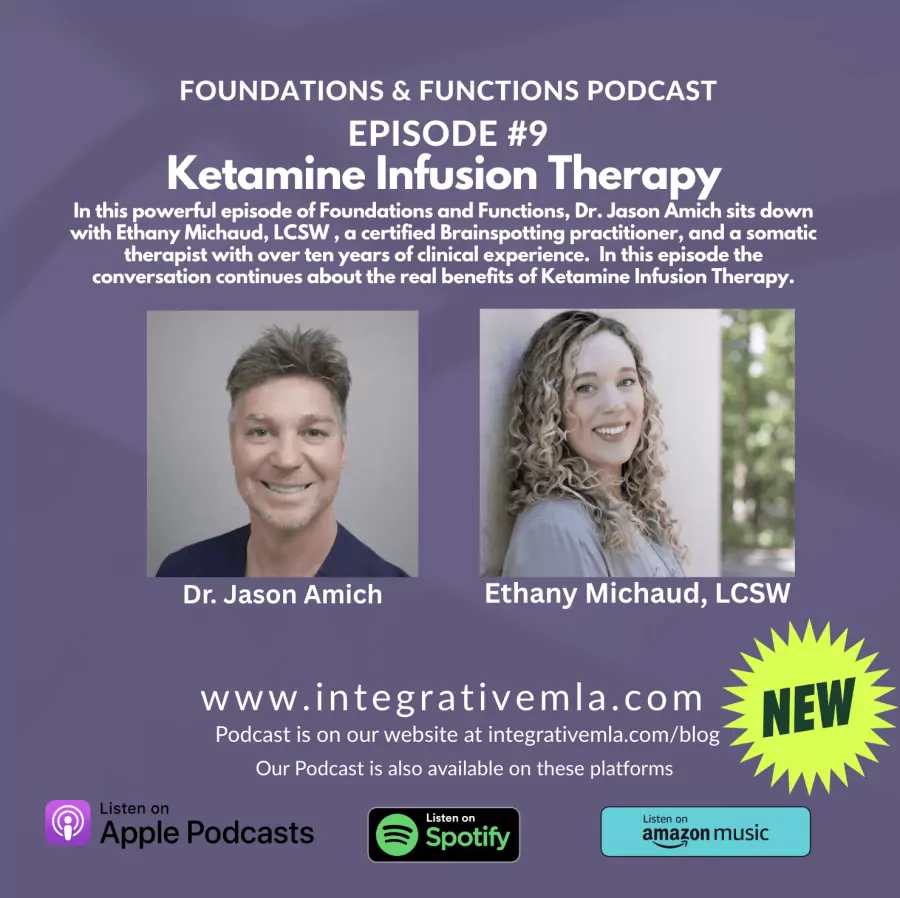
In this episode of Foundations and Functions, Dr. Jason Amich is joined by therapist Ethany Michaud to explore ketamine-assisted therapy from the therapist's perspective. Together, they unpack how ketamine is being used as a powerful tool for people struggling with treatment-resistant depression, anxiety, PTSD, trauma, grief, and other deeply rooted emotional challenges. Ethany shares how traditional talk therapy, medication, and even deeper somatic approaches can sometimes fall short, and why ketamine, when paired with skilled therapy, can help patients access new pathways for healing.
The conversation also dives into how neuroplasticity works, how therapists screen for the right candidates, and why safety, trust, and a strong partnership between doctor and therapist are essential for success. Dr. Amich and Ethany address common misconceptions, including fears about addiction, personality changes, and safety concerns, while highlighting the hope many patients experience when long-standing patterns finally begin to loosen. This is an insightful, reassuring episode for anyone curious about how ketamine-assisted therapy works and why it may offer new possibilities for healing when other treatments have not gone far enough.
Show Disclaimer
The information provided in this podcast is for educational and informational purposes only and is not intended as medical advice. The content is not a substitute for professional medical care, diagnosis, or treatment. Always seek the advice of a qualified healthcare provider with any questions you may have regarding a medical condition.
If you would like more detailed medical information, please contact Integrative Medicine through their website at https://integrativemla.com/
Show Transcript
-
- 0:02 Welcome to Foundations and Functions Weekly Podcast, where we return to when medicine actually made you better. The information provided in this podcast is for educational and information purposes only, and is not intended as medical advice. The content is not a substitute for professional medical care, diagnosis, or treatment. Always seek the advice of a qualified health care provider with any questions you may have regarding a medical condition. Today's episode features Dr. Jason Amich, in a continued discussion on ketamine therapy. Thank you, everybody, for joining us today. Welcome back to Foundations and Functions. This is Dr. Amich.
- 0:43 I'm here with Ethany Michaud, who is a therapist that we collaborate with for our ketamine -assisted therapy. We had a great response to our last podcast with my friend Micah that talked about ketamine -assisted therapy from the perspective of the patient. So today we want to talk about ketamine -assisted therapy from the perspective of the therapist. So we're happy to have her here. And so I just want to take a second to welcome you, Ethany. Thank you so much for taking the time to join me. And just give us a quick intro. Tell us a little bit about yourself and about your practice. Yeah, thanks for having me. Yeah, so my name is Ethany Michaud. I own Circle City Alliance Therapy and Consulting. My office is in like Northwest Indianapolis and pretty close to Carmel, so luckily very close to where you guys practice as well. I have been a therapist for about 10 years now and kind of started working with Dr. Amich and Dr. Pabla on ketamine -assisted psychotherapy, what, two or three years ago now? I think so. Yeah. And it's been a really cool experience. Kind of what I specialize in is taking clients that have tried just traditional talk therapy, all the, you know, medication management, and it's just not working.
- 2:13 And I take them a little bit deeper. And so I specialize in ketamine -assisted psychotherapy and in brain spotting, which is pretty similar to EMDR. Um, often people will be more familiar with what EMDR is, um, and kind of search for that. Brainspotting specifically is, um, similar, but a little bit more, um, flexible. And so I like that about it, uh, versus EMDR specifically, because I can really just kind of meet the client wherever they're at and go from there. Um, so yeah, that's kind of what I do. And who's, who's your typical client or, I mean, do you see. You know children all the way through adults or do you kind of have a special demographic range that you stick to? Yeah, I work with adults at this point. Um, and mostly I specialize in trauma addiction, um, grief, anxiety and depression. Um, but most of my clients have had some sort of trauma.
- 3:10 Great. Well, not great. Not right. Great that it aligns with this so well. And so I'm excited to jump into this. So. Let me just kind of start off by saying, you know, ketamine is a very interesting thing to me. And so I often kind of think about how did this party drug become one of the most promising treatments for things like treatment -resistant depression, anxiety, even PTSD. And so I say that with a little bit of jest because it really didn't ever begin as a party drug. So what I describe as kind of the evolution of ketamine from hero to villain back to hero.
- 3:49 And really the story of ketamine started before 1960, but 1960 was kind of the sentinel year for ketamine use. And it wasn't until 1970s that the FDA actually approved ketamine as an approved medication in the United States. The World Health Organization has had ketamine on its list of essential medicines for decades. Even as far as in the year 2000, Yale School of Medicine was doing some random controlled trials with ketamine and were having some great results. Fast forward that to its villain concept. So, unfortunately, in the early 2000s, ketamine emerged as a street drug, party drug, and unfortunately a date rape drug. And so it was being used indiscriminately, even in inpatient mental facilities. Fortunately, it caused quite a bad stain on ketamine and its usage. Now we return to its hero story, where we realize with continued study, with these continued RCTs, which are the gold standard of science inquiry here, we're seeing this amazing set of data emerge, describing and demonstrating ketamine's role in treatment of treatment -resistant depression, anxiety, and even PTSD.
- 5:08 So the FDA has approved ketamine for, or a form of ketamine for, treatment -resistant depression, which is something that you talked about. Some of your initial clients were folks that have, you know, been dealing with it for a while. Can you talk a little bit about treatment -resistant depression and what that sounds like? Yeah, absolutely. I work with treatment -resistant depression, anxiety, the PTSD, kind of all of those symptoms can eventually be treatment -resistant. Sure. Yeah, a lot of my clients will have tried traditional talk therapy. They've tried all the SSRIs, you know, and either, you know, that doesn't go well for their specific body chemistry or they're allergic to it or some other kind of thing where they just simply can't take that medication. and it just doesn't work for them. Some clients it makes anxiety worse or depression worse or suicidal thoughts. And there are definitely some clients that truly the medication aspect just doesn't work for them. And I kind of view it as more of a band -aid. It doesn't really fix the underlying issue. The underlying issue really lives in their nervous system. And so I do, I get a lot of clients that will come to me saying you know I've been in therapy for on and off for my whole life or for years and years and we just talk in circles and it's not really going anywhere.
- 6:22 What I will usually start with is brain spotting because it is a less invasive approach kind of based on eye positioning and so we kind of know that with our eye positioning we can kind of unlock where your body is holding the trauma or holding its unhelpful belief systems or whatever we have that we're dealing with and so We kind of line up your eye positioning a specific way. and your body will process for you, which is very cool to see. But sometimes even that level is not enough. And so when I've encountered that in my practice, and I'm like, okay, we're trying all the things, we're going deeper, you know, we're working with the nervous system, not just our frontal lobe, where we're just, you know, making connections and thinking through it, we're feeling through it. And if that is also not enough, then we need to think about moving into ketamine assisted treatment. And so Sometimes people's brains just really don't want to budge and maybe that's because these specific patterns these behaviors have kept them safe After a trauma and so not actively resistant to change but their bodies just won't allow it to happen and that comes from a Survival standpoint and that's that's a pretty deeply ingrained survival instinct to have yeah, that's where ketamine can kind of come into play And we've seen really good results with that.
- 7:44 So if we need to go even deeper than a somatic type of therapy on top of talk therapy, then we'll bring in ketamine. That's great. And I like, you know, that you are focusing on the brain, the body and the emotion part, kind of bringing all that in. So real quick, I'm just going to do a quick overview of how ketamine works. And I want to jump into that because you brought something up when you said these patterns of behavior and it's kind of these rigid thought patterns. So we'll jump into that. But it's kind of the beauty of how ketamine works, specifically in that area of neuroplasticity. And so if you really want to get the deep dive into the biochemistry, I say jump back and listen to that podcast that I did with my buddy Micah. But just for today's, you know, 30 ,000 foot view, you know, the skinny of it is that ketamine focuses and acts on the NMDA receptors. And what this does is it regulates glutamate. Glutamate is the number one excitatory neurotransmitter in our brain. And what's really kind of a cool paradox of how ketamine works is that initially it actually blocks that receptor.
- 8:54 It actually slows down glutamate. But really, the end result is it actually kicks up glutamate. It's like slow down so you can go fast. And in doing that, when you get that surge of glutamate, it really opens up those neurons to want to reach out and find new pathways and find new connections. And so that's where neuroplasticity, are you comfortable talking about neuroplasticity? Absolutely. So tell me, what's neuroplasticity? Yeah, so it's it's kind of a trending word right now. And that's great. I think that more people are kind of getting on board and learning about this.
- 9:29 I talk about it with my clients in the realm of like rigidity. And so sometimes, consciously, they can know that their, their reactions, their thoughts, their beliefs, you know, core beliefs, what their body believes, is unhelpful at this point. But they just cannot seem to overcome that. And so when I talk about petamine treatment with them, I kind of talk about how it'll loosen up how rigid your body is. you know, holds on to these beliefs, these patterns, these behaviors, and that gives us access then to rewire a little bit. I do prefer to know my clients pretty well, have really good rapport with them, feel, hopefully they feel really safe in session with me so that we can really pick out, okay, what kind of core beliefs or behaviors, attitudes would be more helpful for you at this stage in your life, where you're hopefully safe, where, you know, you've overcome, you know, come through the trauma, and that's not gonna be reoccurring for you.
- 10:30 Really working to kind of rewire when the ketamine treatment kind of puts their brain into a state where it's more pliable and we can move things around. Yeah, I kind of see it in my own head as, you know, you have these paths, right, maybe these trails in this forest of life, and we forge these trails and we We're comfortable with them. We know where they lead. We know how to navigate them and get to them. You know, I think it was Robert Frost that said, right, that what if I came to a fork in the road and I took the path less traveled. That's made all the difference. Well, I don't want to take the path, you know, that's less traveled. I want to stay on the path that I recognize that I'm safe, but I know where it's going to go. And sometimes our brains do that even when it's not good for us.
- 11:17 And so I feel like ketamine kind of opens up your perspective to say, hey, this trail here, this may be a new path to take. That's actually going to get you to a better place or get you to a healthier, safer location than always ending up at the edge of the cliff somewhere, you know, and not knowing. you know, how you're going to react to that. So that's just kind of in my brain when I think about neuroplasticity and how ketamine helps break some of those old patterns and opens up your mind for or new opportunities for, you know, connections to memories, connections to behaviors. So often our patterns of behavior, our patterns of thought are so, like you said, rigid that it's hard to believe that there's anything other than. Yes, absolutely. So talk to me a little bit about your screenings and selection process, how you go through Kind of determining which patients you feel like may be good candidates for ketamine, maybe some that maybe ketamine may not be good for them right now.
- 12:21 Yes. So I will do a full screening. So if I don't know the client in front of me, they're new to me, I will do what's called a bio -psycho -social assessment. It kind of just looks at all their whole life, all of their life domains, their spiritual, their social, their medical, mental health, just kind of a full spectrum assessment of their whole life. Look into psychological history. One contraindication that we want to avoid is psychosis. And so if they have a history of psychosis or, and I know that there are some Issues with like certain cardiac things, you know, if I if I clock any of that in the in the intake specifically, I would probably talk to you about that just for safety reasons. But most of the people that I have kind of done an intake with. have been generally in a good headspace. They're not in an acute crisis. We don't want their whole life to be falling apart and then to dose them with ketamine and then try to rewire. We want them to have generally a stable safe place to kind of return home to, that sort of thing.
- 13:33 So good support systems, people that have done the work or they've tried all the medications and are still feeling stuck, like therapy alone hasn't moved the needle. for them. Again, we kind of talked about treatment -resistant depression, complex trauma, anxiety, that CPTSD, you know, that goes deep, usually into childhood. It doesn't have to, but oftentimes it does. You know, the only contraindications are really psychosis, and then some physical health concerns, which I always defer to you to kind of check that out. But yeah, most of the people that that we have worked with together have just been feeling really stuck and having trouble kind of overcoming that.
- 14:14 Yeah. And again, that kind of goes back to that neuroplasticity and being able to break that mold of behavior and thought. One of the things that I found has been really cool in partnering with you and other therapists and folks that are coming to us, first of all, is the strong partnership. And that's really important in our practice that our ability to provide ketamine in a safe environment absolutely requires that they have an active relationship with a therapist ongoing. That's for number one. Number two is I really like to see the improvements in their GAD scores, their PHQ -9.
- 14:52 So I know those are kind of really popular things out there. So can you explain what, what a GAD is or what a PHQ -9 is? Absolutely. Yes. Um, so the GAD score, um, it is a screener for anxiety, um, and it's a generalized anxiety disorder. Yes. Um, that's what GAD stands for. And then the PHQ -9 is for depression. So they're very similar screeners. It'll feel to a client like a quiz and you get a score at the end. and they're evidence -based, you know, they're backed by science. and we kind of use these frequently throughout treatment.
- 15:28 So I'll get a baseline before we ever do a ketamine intervention, we'll get a baseline score, and then what we want to see is that we want to see those scores change. And essentially, the higher the score on those screeners, the worse you're feeling. And so if, you know, you're an 18 on the GAD, you're not feeling good. You've got a lot of anxiety. If you're a 21 on the PHQ -9, you're very depressed and it's hard to get out of bed and things like that. And so we want to see those scores go down over time.
- 16:00 And truthfully, in our time working together, we have seen Significant change in those scores. Are there any other screeners anything else that you do? Yeah, we will have specific goals Like if we're working on let's say they have a core belief of I can't let people Too close to me because I'll just get hurt, right? That's a that's a pretty common one. Unfortunately, you know, a lot of people are hurt by other people with trauma And so they have trouble making friends and trusting people to get close to them in their life We will you know find a specific marker to see how intensely that is coming up for them.
- 16:34 And so I usually use a scale, you know, zero to 10. And so if, if 10 is the worst you could ever feel about a friend spending time with you, for example, you know, that's a 10 is you're, you're having a panic attack about that, right? That person wanted to give you a hug goodbye and you just couldn't. These are just examples, but sure. If that is a 10 out of 10, then I want to see that number go down too. I want to see, you know, some exposure therapy after, after ketamine, like let's, practice giving our friends a hug and and see how that feels in your body. And, you know, does that, you know, bring up the same pressure in your chest? Does that also make you want to cry every time you do? And if we see those symptoms go down, you know, it's a subjective score. But if we see that number go down, that's what we want to see that, you know, happening there, too. I use a lot of scores. My clients are very used to giving me lots of numbers of things. But yeah, we look for specific goals and progress toward those goals as well.
- 17:27 And I think those scores are helpful. In some of the patients that I've discussed those scores with, you know, even from our angle, from the administration of the ketamine, sometimes it's been interesting to hear them be surprised at the score. They may not necessarily feel differently, necessarily, but then when they kind of look back and go, well, you, again, you were at 21. Now you're at nine. Right. And they can say, yeah, wow. Yeah. I didn't realize that. One of the questions on the GAD will ask, over the last two weeks, how often have you felt that you could not Stop or control worrying. Really, we've had clients that would rate three out of three nearly every day. That's what that score means. When we kind of go through it, you know, month after month or even every two weeks or so to make sure that we're on track, I'll say, you know, two weeks ago you rated that out of three and today you're at a one.
- 18:18 What's that feel like for you? Like, where are you noticing that difference? And you'll kind of see the light bulb moment where you're like, oh my gosh, you're right. Wait, I went a whole day without worrying about something. And then we'll kind of reflect on that. What was that like? How does that, you know, show up, you know, meaningfully in your, in your life, in your relationships at work, at school or whatever you're doing. And it's, it's really cool. It's cool for us to see because we don't see the client every day. I see them, you know, once a week or, or whatever the, the structure looks like. And so they look. vastly different to me, but they live with themselves every day. And so it's really cool to reflect and look at where they started and where they've ended up. And that's something I talked with him about is saying, look, give someone permission, give your spouse, give your best friend, give someone permission to let you know how you're doing and check in with you.
- 19:10 A lot of patients will ask me, well, you know, how often do I have to come get ketamine or am I doing it every day? for the rest of my life? And the answer is, I honestly don't know. It's going to be very specific to the patient, but I will say the patients that we have on maintenance doses of ketamine, very interesting how often a spouse might say, you know, maybe you should think about getting another dose. Or a child would say, mom, okay, I think you might need a little touch up on ketamine. And they've allowed that.
- 19:39 And so they may not necessarily see some of those reverting back to some of the old habits other folks had. And they, without question, without exception, all of them that have use that feedback, really get great results with it and really enjoy their time with their families more and kind of who they are. I think it's interesting in some key points to make about ketamine -assisted therapy has to do with some of the research on patients who've had treatment -resistant depression, PTSD, and anxiety. So in some of the studies, up to 91 % of folks who were screened positive for symptoms of generalized anxiety disorder, that's what that GAD score kind of helps, 91 % fell into a milder category or had significant clinical improvements.
- 20:25 Folks that were screened for depression, so 79 % of people who screened positive for symptoms of depression who combined ketamine -assisted therapy with their current counseling therapy, whether that's psychotherapy, EMDR, you know, whatever else we might be trying, DBT, CBT, all the things. Yeah, all the things. They had significant clinical improvements and reductions. 86 % of people that tested positive for PTSD left the program. screening negative for PTSD. Negative. Not an improvement, better. Gone. So, I just, and then 92 % had some significant clinical improvements in their life, in work environments. So, I think those are really important too. you know, highlight here when we're talking about how ketamine -assisted therapy can be an adjunct in a tool in your toolbox for you know, changing some of those, uh, longstanding behaviors, longstanding thought patterns and kind of getting out of that rut. Absolutely. There's, you know, I'm, I'm sure eventually I'll, I'll hit a point with a client where it's not helpful, but so far in the last couple of years, a hundred percent of the clients that, that we have shared have, have come back and had significant change and improvement.
- 21:43 And it's just really, really cool to see. And that, that kind of confidence going in is really helpful. So I'm going to put you on the spot a little bit here. I know I promised I told you I wouldn't do it, but I am going to do it. That's okay. And that is, what about some of those that are kind of on the bubble? Tell me about some of the folks who are maybe hesitant or if they have some misconceptions. What, what do you, do you have some that you're kind of like, you wish they'd do some ketamine, but maybe there's some resistance. Tell me about that. Absolutely. Um, yes, there are a number of, of hesitations that people will bring up when I say, Hey, you know, we've been working on this for a year or more and we're just really not I'm not seeing even brain spotting, which is very deep. I love brain spotting. Very deep work. Very positive for a lot of people. But even that is not moving the needle enough. I'll bring it up to the client. And so many clients have asked me, is this going to change who I am fundamentally?
- 22:36 Is this going to make me a different person? I'm afraid that if I try this, that I'll become addicted to it. I'm afraid that it'll, you know, make me have different interests or change my personality. Absolutely not. That has not been my experience. I don't know if that's been your experience either. The things that it does help with is kind of reducing their negative symptoms, right? The symptoms that they are struggling with, you know, hypervigilance or they're having difficulty sleeping at night, they wake up all hours of the night in a panic attack, the brain fog of it all, you know, just their nervous system is just on all the time, because they feel like they have to be to stay safe. It's usually, you know, PTSD is kind of what that looks like. And so what it does do is help give our brain the opportunity to form new healthier connections.
- 23:28 What it does not do is change who you are as a person. Not to be too, I don't know, blunt about it, but isn't it kind of the point to be a little bit different than what you have been? Yes. In some ways, yes. But I think I understand the question is, you know, who I am fundamentally. Yeah. That's a misconception that I think is easily, you know, erased from looking at the data and just talking to people that, you know, it really kind of makes you better at who you are and who you want to be.
- 23:55 It gives you more space, more capacity to live your life in the way that you want to. I even had somebody recently ask, um, is this going to make me like, for example, not love my husband anymore? Am I, am I going to be, am I going to feel so different that the things I love now won't matter to me anymore? Scary. Those were scary things, right? Oh yeah. And that's just, again, not been my experience. I haven't seen that. And in fact, the opposite, what I have seen is that it. allows people more capacity to, instead of, you know, focusing on survival every moment of every day, of protecting themselves constantly, they're able to kind of relax a little bit more. They're able to, you know, dive more into the relationships that they want to foster, um, with safe people, of course. Sure. That's, that's a pretty common misconception.
- 24:44 People are very afraid of what it will kind of turn them into. And, and that's valid, I think, you know, especially for people who've been traumatized I would expect some hesitancy, you know, walking into something this deep and not really knowing what the outcome will be. That makes sense. I remember one, one patient telling me through the ketamine experience, she said, you know, I had this, I kind of relived this moment and it wasn't a big deal in the moment. But now that I've kind of had some time from it and with the ketamine, I realized, wow, I think that affected me a whole lot more than I realized. And I would never have thought about that. I haven't thought about that situation my entire adult life. But now that I've kind of gone through this, I kind of sat back and went, wow, that's really been something that's affected me. I'm going to work that out. I just had to sit back and say, okay, that's great. So yeah, I really love that evolution with ketamine. What other misconceptions or what other things do you hear from your patients? other main misconception is that they feel like ketamine is new.
- 25:49 And so maybe my my client that's that's, you know, on my couch, didn't go through the party drug, you know, era with ketamine. And so they think that it's a brand new drug on the market, and that there's not enough research behind it. And we don't really know how it goes. And obviously, as you described earlier, That's just not the case. And so that's a pretty common misconception as well. And then I have a two page APA style reference list. I'm happy to share with them. I love it. APA nerded out on. But yeah, the only other misconception is that they think that they're going to, I guess, not come down from a high, right? That they'll get stuck there and now they're in active psychosis for the rest of their lives. And obviously, you and I would not be doing this if that were a concern. And so, yeah, I think just educating people and kind of talking through what our experiences have been has been really helpful in kind of dispelling some of those scary rumors. Yeah, and I talk a lot, you know, I still do some critical care work. I use ketamine, I would say, really just about every shift where I'm at least thinking about ketamine as an option for patients by
- 26:55 every shift that I do. And it's a very different way of dosing it for this than in an ICU or an emergency department setting. And we're going to use a lower weight base dose and we're going to give it over a longer period of time. So the nice thing about ketamine is it acts quick, but it doesn't stick around for a long period. So typically within an hour, after the infusion. I kind of equate it to people sometimes like this is think about when you get the nitrous oxide or the laughing gas at the dentist, right? I mean, you kind of just don't care about what's happening during that moment. And then, yeah, once you're done, we don't like people driving themselves home. But, you know, yeah, it's not these lingering, you know, side effects. As far as, you know, addictive nature of ketamine, again, the dosage that we're using and the frequency we're using it and the intentionality that we're using it really keeps it at an extremely low level. You know, and what I tell people is, you know, during the ketamine infusion, I've had people say, is it just getting high in my doctor's office?
- 27:53 Is that right? Well, it's not the goal. People do experience some pretty intense, emotional and sometimes uncomfortable experiences. And what's fascinating is when I asked them, How was that? Across the board, it's usually very difficult for them to actually describe what they experienced, put it into words. So it's a lot of visual kind of descriptions that they use for that. But that's the typical experience that people have getting the low dose. And we do IB, ketamine, and again, my my previous podcast, we talk a lot about, you know, why we do IV versus intranasal versus oral. There's a lot of good information about that. It just has better bioavailability and it's a lot more controllable from that perspective. And then finally, kind of the idea of, you know, is ketamine dangerous? And there's been some things in the media and people worry about. the dangers.
- 28:50 One of the reasons I like it in the critical care and emergency medicine setting, it doesn't have the dangers of a lot of the other drug options that we have. It doesn't depress your central nervous system. It doesn't slow down your breathing. It doesn't have as much impact on your cardiovascular system or your blood pressure, heart rate, that sort of thing. So from that perspective, It actually has an extremely safe profile compared to other medicines that you may hear about being used in hospitals in emergency and critical care settings or anesthesia settings. Ketamine is kind of a go -to drug. for a lot of those environments because of how safe it is. And I always tell people, anything can be dangerous in the wrong hands in the wrong step. You know, for our practice, you know, you are monitored the entire time. There's a clinician in the room with you the entire time. You know, we're monitoring your blood pressure. We're monitoring your heart rate. We're monitoring your oxygen saturation. You know, these things are probably overkill, but I do know I've had some patients give feedback that other places they've gone, there isn't that level of monitoring.
- 29:57 The psychology, I think, of kind of being just left alone, given this thing, you're out here kind of on your own to manage all the things that are happening is really unfortunate. And so that should not be the norm. So that would be my message for anyone out there. If that's the situation, ask these kinds of questions. How are you being monitored? Who's monitoring you? And what their training and background is. Sharing some experiences, both as you as a clinician and maybe some specific patient experiences that you've had. ahead of the last couple years. Absolutely, yeah. Yeah, some things that I've really noticed with lions been a little bit different based on when I've seen them. I will usually try to get them in within 24 hours after their dosage, and then I can tell when I've seen them directly after their dose, they're maybe still a little bit out of it.
- 30:45 Not in a bad way. They're actually very calm, very relaxed, very happy, very chill. Like, you know, kind of like, that was so cool. It's just, you know, so calm. And of course, we've gotten all the feedback that they just feel really safe with you guys. And it's just been a really good experience. If I see them like, you know, the hour after they get their dose, it's a little harder to do some of the deeper work. But if I see them at least half a day after or that next morning, that's kind of the sweet spot I've found. You know, of course, it really depends person to person. But yeah, what I've kind of noticed with clients is just kind of like a loosening of their rigid thought patterns. You know, if the week before I said, hey, let's really work on this core belief that you hold that you're unlovable or unworthy of love.
- 31:30 and you kind of see them physically tense up, their shoulders, you know, basically on their ears, you know, and they just tense up and you see their eyes darting all over the place. And you can kind of visually see their nervous system trying to protect them, but then when they come after their dose with you and then they walk into my office and I say the same thing, hey, how comfortable do you feel talking about this belief that you're unworthy of love today? The loosening of all of their nervous system responses has been just really, really cool to see.
- 32:03 Their shoulders stay relaxed. They're kind of melted into the couch a little bit. They're just like, sure, whatever you want to talk about, let's do it. And then we kind of work to rewire, you know, let's look at the evidence. And that's just, you know, the traditional psychotherapy piece. You know, what makes that belief true? Is that belief true at this point? You know, do we have other pieces of evidence that make it not true? Is there a different core belief or can we challenge that core belief a little bit? Again, that's traditional psychotherapy. There are other things we can do with like DBT, dialectical behavioral therapy.
- 32:37 Maybe we need to work on accepting certain core beliefs. And we'll, you know, it's a case -by -case basis. I think the biggest coolest thing that I've seen is just the physical signs of relaxation. Their expressions are softer and, you know, instead of sitting up on the very edge of the couch, you know, straight back, they're able to like relax a little bit and kind of cross their legs and kick their feet up a little bit. That pressure, that weight that they felt in their chest for most of their lives is lessened. And do you feel like you're able to get in and reach in? to those core beliefs a little bit easier in that state? Absolutely. They're more willing to go there. They're more comfortable going there. It doesn't feel as scary to them to talk about that stuff. It's just the openness is very cool to see. And they're able to focus a little bit easier. And so sometimes trauma will make it look like we have ADHD when we don't. And our brain is just kind of jumping all over the place. People are always very focused. They will come in and They're very present.
- 33:40 They're very, you know, aware of their bodies and, you know, not kind of disconnected anymore. It's just kind of an ideal situation for therapy. Do you find some aha moments? I mean. Absolutely. Sometimes people have those aha moments, you know, while they're kind of getting the ketamine at your clinic and then they'll come talk about it. We really. You know, it's been that time kind of linking like, okay, well, that makes sense because of this and okay, well, let's let's adjust this and you know, what kind of evidence can we look for over here? And so lots of aha moments and they'll they'll report feeling like Pope and and like peace. It's so interesting. We haven't talked about that. We haven't but that word. Yeah. Yeah. I would, I mean, so often, uh, you know what, I'll just ask a closing follow -up question, you know, Hey, so overall, how do you feel?
- 34:34 Right. In some places. asking more for clinical reasons, you know, hey, any headaches or dizziness or nausea, you're going to throw up on the floor. How's it going? It's so odd and interesting and beautifully odd that so many different people from all walks of life would use the word hope. And I love that you just said that because you're hearing that too. So that's, that was a really, I wanted to make sure I pointed that out because it's such a cool thing to hear when someone looks you in the face and say, you know what? I have hope for the first time. Yeah. Like it removes that block of, you know, where our brain has said, Nope, this is how I'm going to be forever. This is it. This is my reality. And, and it doesn't have to be. Yeah. So feeling that hope can be really empowering.
- 35:19 Yeah, awesome. I would definitely say find a team that you feel safe with. On the therapy side of the world, we know that at least 90 % of our helpfulness as therapists is the therapeutic relationship. And so feeling safe in my office, feeling safe to tell me anything that's coming up for you, knowing you're not going to be judged, knowing I'm not going to be like, wow, that is crazy. I'm never going to think that. I'm never going to say that. And just really feeling safe with the people that you're going through this with because these are some of the deepest kind of darkest experiences of a person's life. And to share that with somebody, that somebody needs to be a safe person. The other side of the same coin, I think finding a doctor who you also feel safe with, because that doctor is going to be in the room with you, hopefully, as Dr. Amick suggested, is going to be in the room with you and going to be walking through this journey with you as well.
- 36:19 And so finding a treatment team that you feel confident and safe with, I think is the number one Indication that this is going to go well for you. Okay, imagine you're in a room full of therapists who are maybe kind of interested in starting their patients or clients on ketamine, but maybe they're not sure. What would be your one piece of advice that you would give the room to say, this is what you need to know as a therapist about ketamine -assisted therapy? Yeah, I would definitely recommend that they talk to you, and I actually have been in a room even recently with a group of therapists, and they were asking me all of these questions about it, and I said, you know what, yeah, so you probably need to talk to Dr. Amick and just kind of demystify it a little bit. I hail from a long line of dual diagnosis therapists, and so we were kind of trained to treat addiction and mental illness together.
- 37:12 And we were trained to do that in a community mental health setting. And so, you know, thinking about giving a client that is, you know, struggling with being homeless and addicted and, you know, having an A -score of 10 out of 10, which is another one of those screening tools that gives us information about PTSD. A 10 out of 10 means you've had a lot of trauma. You know, for a lot of those therapists, thinking about giving somebody ketamine or even considering ketamine can be really scary. And so I think really kind of demystifying it, doing some research, talking to safe doctors like yourself, maybe even asking if you can kind of shadow over a day if that's an option, of course, if the client patient is comfortable with that. I think once you get into this, it's a lot less scary. Yeah. And I think for people like you and me, it's easy because we've seen the outcome.
- 38:09 We've already seen the outcome. Yeah. And it's so worth it. Definitely. And before you can get to that, you have to take that trusting step. I think that's great advice. So let's chat a little bit about how we do work together, kind of the system that we work in. balances that we have in place. So again, I mentioned that we want to make sure that You know, not only do patients have access to therapy, but they're actively involved in therapy. We don't do standalone ketamine infusions in our practice. Patients can come in a couple of different ways.
- 38:43 They may come to us, specifically to our practice, and we say, gosh, this would be a good candidate for ketamine. And so we would refer them to a therapist if they don't have one already. But then talk a little bit about your side, when if someone comes to your office and how we can kind of go back and forth about how that flow works. So the trigger would be, ah, this person would be a good candidate for ketamine -assisted therapy. Yeah. So once I receive that referral from you guys, then I will do an intake assessment. I kind of talked about the biopsychosocial assessment that I'd complete. Make sure that everything checks out on our end, they have good supports at home, that everything is stable, they're not in an acute crisis. Kind of coordinate with Dr. Emick here and kind of find a schedule that works for them. And then I would work them in so that they could see me. at least 24 hours after each dose. We've got kind of down to a science, it works pretty well. On the other hand, if I've been working with somebody for a while and we've been trying other things and it's not working, I might bring that up to the client and say, hey, you know, I found that on my end, you're a good candidate, but I want to make sure that we clear you medically for this.
- 39:54 And so then I would send them over to Dr. Amich for a full medical workup and make sure that they're a good candidate. And that's so important for Dr. Pabla and my partner and I, we both really want to look at you know, root causes. We really kind of focus on that functional medicine, you know, mindset of, okay, what else could be going on? So we want to make sure there's nothing medically wrong that needs to be addressed, whether it's a thyroid condition, you know, any other kind of, you know, medical problem that they're having or something that might set them outside of the parameters for, you know, safety for ketamine -assisted therapy, you know, uncontrolled hypertension is one of them. Recent stroke might be one of them. You know, we should make sure, okay, let's make sure that from a medical perspective, this person is safe to receive this This therapy so I think again for us, you know That just makes perfect sense to ensure that we're gonna cover it kind of the medical clinical side the body side Yeah, and we want you to cover the kind of the behavioral Psychosocial side of that.
- 40:53 I think that's a really important piece. It's a it's a non -negotiable for our practice yeah, which I I think is is really important to note that there are kind of a an uptick of clinics that will just, you know, mail ketamine to somebody's house. Don't get me started on that. We don't have enough podcast space for that. We don't. And it just, you know, it either can be dangerous or, you know, uncontrolled, unmonitored. Unmonitored, right. But then on the other hand, you're also not creating new connections in your brain. And so it's just not really going to change much for you.
- 41:28 So, Yeah, I think the partnership that we have works really well. We make sure that we're covering all of our bases, and we kind of leave no stone unturned. And one of the things that Dr. Pabla and I really, really believe in is making sure that we get you healthy safely. There are many things you can find through AI or through internet searches, or you can find, you know, quote unquote, you know, influencer experts on different topics. And we're like, well, maybe, but let's get you healthy, safe. And that's a physical perspective. And I know we really enjoy working with you because I feel like that's how you believe as well, from a behavioral perspective.
- 42:06 We want to get there, but we got to get there safely every time. You know, this is really just about the brain's ability to adapt, change, and ultimately rewire itself. And then we used to think that neurons are fixed and non -regenerative and kind of once they're set, they're set. And what we know now is that's not necessarily true. And we know that because, you know, patients who have had strokes before or certain specific types of brain injury or trauma, we know that, you know, other neurons can kind of take over for that. So there's, there's some evidence out there already that neurons can, can do some pretty cool stuff on their own. And we can help rewire that effective for us. If you want to form new memories, recover from injuries, if we want to break thought patterns that are unhealthy or unhelpful. and that the key here is that ketamine causes a temporary state of enhanced neuroplasticity.
- 42:56 That's such a key point to make, that it's this narrow window of enhanced neuroplasticity, where again we can rewire those thought patterns or behaviors, we can address experiences that seem stuck or rigid, and it just allows for new paths to be forged when they're combined with therapy. Thanks so much for spending time with us and helping your patients and clients reach their best potential. So tell us a little bit, where can we find you? Yeah, absolutely. You can find me at ccatherapy .com. Again, my business is called Circle Steady Alliance Therapy and Consulting. I'm here in Northwest Indianapolis, but I am licensed throughout Ohio and Florida so far, so I can I work with people virtually, probably not with you with ketamine if they're in Florida. But yeah, you can also find me on Instagram or TikTok. I am at CCA therapist. Again, my name is Ethany Michaud. That
- 43:52 is spelled E -T -H -A -N -Y M -I -C -H -A -U -D. It's like Bethany without the B on it. I'm pretty easy to find if you Google me. Great. Awesome. Thank you so much for your time and for listening today. If you have any questions about this, please feel free to reach out to us on our website, www .integrity .org. .com. But thank you for spending time with us today and we hope that you find a way to get healthy safely. The information provided in this podcast is for educational and information purposes only, and is not intended as medical advice. The content
- 44:26 is not a substitute for professional medical care, diagnosis, or treatment. Always seek the advice of a qualified healthcare provider with any questions you may have regarding a medical condition. If you would like more detailed information, please contact Dr. Amich or Dr. Pabla at Integrative Medicine through their website at integrativemla .com.